Posts

What is figgy pudding?

Image
We want some figgy pudding So bring it right here! Figgy or fig pudding is a generic term covering a number of medieval dishes served at Christmas. These could be sweet or savory and usually included figs,  honey seasonal fruits and nuts. Later, figs were often omitted while large measures of rum or other distilled alcohol became obligatory We Wish You a Merry Christmas Figgy pudding has entered popular culture via the carol. This originated in the west of England and was revived in the Edwardian period by composer, conductor and organist Arthur Warrell (1883-1939).  We Wish You a Merry Christmas is from the wassailing tradition, where villagers visit the gentry demanding ale to celebrate the season.  This combines jollity with a  barely concealed menace hinted at in the words: We won’t go until we get some So bring it out here! Doubtless Mr Warrell played down the drunken rudeness in his five part madrigal version for the University of Bistol....

How We Learn Language?

Image
Are we born with the capacity to speak a language? Or do we learn exclusively through imitation? This is a quick guide to three key theories Behaviourism Sees language as the product of our interaction with our environment. We learn it  like any other skill through imitation and practice. Important aspects of the theory are: reinforcement (positive and negative), repetition, small sequenced tasks and consistency.  Many educational policies are based on social interactionism  - a more nuanced variant of behaviourist theory. Social interactionism focuses on the relationship between the learner, his/her environment and the context under which learning occurs. Key Theorist : BF Skinner Key term: operant conditioning : Put crudely, rewiring the brain to offer reward for successful language acquisition. Skinner saw this as a kind of mechanical process with four elements: motivating operations, discriminative stimuli, response, and reinforcing stimuli. Strengths :  s...

Ten Dickensian eponyms?

Image
Dickens festival, Rochester. Fagin hanging with Miss Havisham & the gang  I am well aware that I am the ‘umblest person going,” said Uriah Heep, modestly . Charles Dickens, David Copperfield No novelist has been more inventive in using character names to express character traits. Ernest L. Abel identifies seventeen examples that have entered general English. These ten are perhaps the best known: Scrooge -  miserliness, anti-Christmas, bah humbug etc  Mr Micawber -  spendthrift, ludicrously optimistic ‘something will turn up’  Fagin - charming, ruthless, leader of a gang of child thieves. Miss Havisham - embittered reclusive spinster Uriah Heep - obsequious, toadying, false humility. More recently humble brag   Podsnap  - complacent jingoist who “stood very high in his own opinion” Pecksniff -  hypocritical Pickwick - amiable bon viveur, 'Pickwick paunch' Gradgrind  -  hard, ruthless businessman who reduces everything to mon...

Origin of laughable?

Image
Laughable Adjective : to inspire laughter: comically ridiculous. A variation based on laugh which evolved from the Middle English laughen, laghen  

How many new words in Shakespeare?

Image
Estimates of the number of new words and phrases used in the complete work of William Shakespeare vary considerably.  In 1942, leading Shakespeare scholar Alfred Hart, wrote that the Stratford playwright is "credited by the compilers of the Oxford English Dictionary with being the first user of about 3,200 words."  That number is now considered an overestimate. But by how much? A British Council website from 2016 suggests 'more than two thousand' while the invaluable Online Shakespeare Biography goes with around 1200.

Origin of word blackmail?

Image
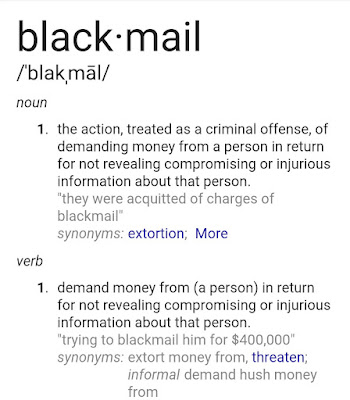
The original meaning of blackmail was not directly connected to the concept of extortion