Posts

Showing posts with the label advanced vocabulary

Five popular phrases associated with the Titanic?

Image
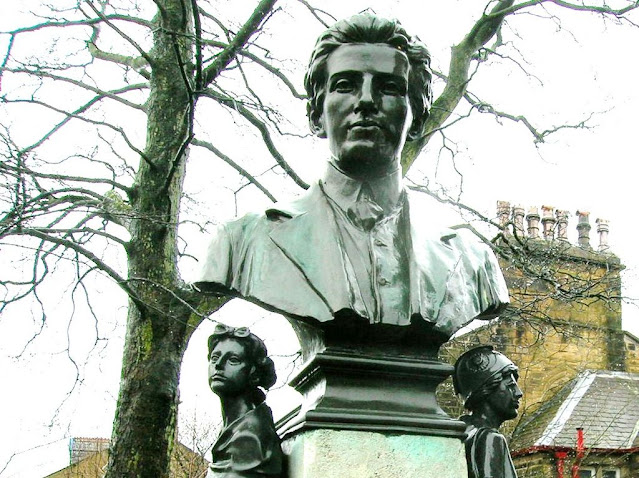
Wallace Hartley, leader of the band that played on Few events have captured the public imagination like the sinking of the Titanic on the night of the 14th April 1912. Five phrases associated with the disaster are still in common use.

Why 'as mad as a hatter'?

Image
'Mad as a hatter' is usually used to describe extreme eccentricity.  The phrase appears in The Clockmaker (1817) by Thomas Haliburton. Perhaps surprisingly, it is not used directly by Lewis Carroll  in either  Alice in Wonderland ' (1865) or Through the Looking Glass (1871).  Chapter VII of the former is, however, called A Mad Tea Party. It also  attended by a hatter, who the Cheshire Cat calls 'mad. It is the  zany antics at the tea party that are being referenced in modern usage. Mercury poisoning The phrase is commonly believed to allude to the grim effect of mercury poisoning on workers (hatters) manufacturing felt hats.  Mercury poisoning  affects the nervous system, with dementia a common symptom.  Victims developed severe and uncontrollable muscular tremors and twitching limbs, called 'hatter's shakes'; other symptoms included distorted vision and confused speech. Advanced cases developed hallucinations and other psychoti...

Where does the word nerd come from? Difference between a geek and a nerd?

Image
nerd nəːd/ noun informal:  a foolish or contemptible person who lacks social skills or is boringly studious. Single minded, expert:  "I was a serious nerd until I discovered girls and cars" synonyms : bore, dull person;  "a computer nerd"

What does inside baseball mean?

Inside baseball  is a term popular with political and media analysts.

Where does the word OK come from?

Image
The word OK entered American English in the 19th century and is now one of the most popular in the language. But there is little agreement as to its origins.

What is Asperger's Syndrome? What is an ASD?

Image
The terminology surrounding this area is confusing, partly for historical reasons.

What is a zero-sum game?

Image
A zero-sum game is  a competition/conflict in which 'the winner takes all'. Whatever is gained on one side is lost on the other.

Where does the name Macintosh come from?

Image
The first Apple logo features Isaac Newton. There is no reference Macintosh or Turin The naming of the world's most glamorous technology company is surrounded by entertaining legends.

Did Frank Sinatra record the first concept album?

Image
A concept album is a collection of songs are linked by a theme.

What is a 'big ask'?

Image
A 'big ask' is an informal idiom describing goal/task that is difficult to complete. It has migrated from British/Australian the discussion of sport into more general English. 

What does it mean to sound off?

Image
Herman Cain sounds off on race, a debate win, and the need to simplify government To sound off is to express an opinion with passion and force.

Words most looked-up in dictionary? Holistic

Image
holistic həʊˈlɪstɪk,hɒ-/ adjective PHILOSOPHY characterized by the belief that the parts of something are intimately interconnected and explicable only by reference to the whole. MEDICINE characterized by the treatment of the whole person, taking into account mental and social factors, rather than just the symptoms of a disease. Etymology:  1939, from   holism   +   -istic .   Holistic medicine  first citation  1960. Related:   Holistically A classic example of a neologism that has crept from academic obscurity into the mainstream. Though proponents of holistic medicine claim the practice has roots in ancient Chinese philosophy, term first appeared in print during the year of President Kennedy's election. The flowering (!) of the New Age movement in late 1960s created increased an interest which has grown exponentially in recent years. Holistic  is often used to describe the aspiration to psych...

What is a bailout? Where does the word come from?

Image
Bailout  has become closely associated with the idea of financial rescue -  to bail out the Greece etc.   But the word has many subtle usages - and two spellings! 1.  bail/bale  is to abandon abruptly as in making an emergency exit from an aeroplane in a parachute.  2.  to bail out  is to remove water from a leaky boat. 3. It is now more common to use  bail   in a figurative/metaphorical sense: The minister has bailed on the government's housing policy ( announced his opposition) . The pilot bailed out The actor bailed on the script  (stopped reading his lines with any show of conviction)  4. 'Bail out' is also used metaphorically but usually with a closer connection to the literal meaning:  The pilot bailed out of his plane. 5. The noun is sometimes spelled as one word:  bailout. 6.   Bail or   bale  - the spelling is disputed but  bail  is probably used more fre...

What does stalwart mean? Where does the word come from?

Image
Atticus Finch:the stalwart hero of To Kill a Mockingbird  A stalwart person is reliable, dependable, resolute (or inflexible depending on your perspective.) The word is probably a  14th Century Scottish variant on a old English term: stælwierðe "good, serviceable," In the US the term acquired a political dimension with a section of the Republican Party  that refused to abandon its Civil War hostility to the south. They became known as the 'Stalwart Party', a label that stuck. A version of this post is included in the  English FAQ Teaching Pack   Download for only £1.99 with offer code CQDWKF0

Why are we “the giraffes of altruism.”?

Image
According to the neuro-scientist, Jonathan Haidt, humans are instinctively unselfish in some key respects. He sees altruism - acting for others rather than out of self-interest - as an evolutionary development.  What's the evidence, Mr Haidt? There are signs that some forms of altruism are instinctive rather than learned. Even a very young child will come to you aid if you are struggling to open a door, for example.  This suggests that an inclination to help others - is at least partially heritable.  But isn't evolutionary theory based on the idea of the 'survival of the fittest'? Co-operation gives humans a competitive advantage over other species But what's with the giraffe reference? The giraffe's long neck gives it an advantage over other species. Being nice - some of the time, anyway - is our equivalent of having a neck that gives you that extra bit of stretch when it comes to nabbing that fruit!  BTW: giraffes & humans share the ...

What is an eysore? And a sight for sore eyes?

Image
English can be a very confusing language. An eyesore is something - typically a building - which is not pleasing to look at. This building is an example:  Eyesore: this building site may turn into a swan one day! A sight for sore eyes is the opposite - something is which aesthetically pleasing to the eye. This is often used as form of flattery e.g. you're a sight for sore eyes What is the origin of eyesore? Shakespeare did not coin the phrase - though he is responsible for eyeball.   He did, however, provide an early example in The Taming of the Shrew, albeit one that is more metaphorical than is typical in modern English:  Why, sir, you know this is your wedding-day: First were we sad, fearing you would not come; Now sadder, that you come so unprovided. Fie, doff this habit, shame to your estate, An eye-sore to our solemn festival! And sight for sore eyes? First recorded example comes in another giant of literature: Jonathan Swift   in A c...
What are phrasal verbs? Is there an easy way to learn them?

Image
phrasal verb noun   [ C ]   / ˌfreɪ.z ə lˈvɜːb /       / -ˈvɝːb / a phrase that consists of a verb with a preposition or adverb or both, the meaning of which is different from the meaning of its separate parts: 'Look after', 'work out' and 'make up for' are all phrasal verbs. Cambridge Advanced Learner's Dictionary & Thesaurus  A phrasal verb is a verb with two parts; the verb and a preposition. The preposition changes the meaning of the verb - to turn on a light is different from to turn a corner. Is there an easy way to learn phrasal verbs? Not if 'easy' means without practice. Phrasal verbs are tricky for English language learners because there are no universal rules. They are the inner secrets of the language; available only to those with the curiosity and patience to discover them. There are, however, a few useful guidelines that can help - see here : Use offer code CQDWKF0 to download English FAQ Teach...

What's the meaning of 'what's up'?

Image
An apparently simple question can cause confusion British and American speakers of English.  An American colleague of mine used to greet me every morning with question 'what's up?'.  I would reply 'Nothing' or 'I'm fine.'  After the third time it occurred to me that for her the question was an all purpose greeting, as in the film title What's Up, Doc   To these British ears it meant 'what is the problem?' or 'is something wrong?'. This confusion is receding, for better or worse. Most younger native speakers now recognise both usages

When do we give a 'heads up' to someone? Why?

Image
When we wish to inform someone about the details of a particular theme, topic, item or person - I'll give you the heads up about the new policy. The idiom   appears to have a military origin -  a heads up indicating that an important announcement was pending. An early citation for the contemporary use of 'heads up from 1977 Early use in the late 1970s stressed the importance of the information supplied: "In a message characterized as a 'heads up alert', intelligence officials warned ... that Arab diplomats had suggested that Ambassador Andrew Young meet with a Palestine Liberation Organization official."  The Washington Post , August 1979 In recent years, however, 'to give a heads-up' has become synonymous with the less glamorous 'inform' English Language 100 FAQ Teaching Pack     -  only £1.99 using discount code  CQDWKF0

What is a hedge fund? And what does it mean to hedge your bets?

Image
Hedge funds are companies which pool capital from wealthy clients with a view to maximising return. They invest in all asset classes - bonds, equities etc - and  because of the scale of their investments can profit from small price movements. The largest hedge funds are also 'market makers' - their investment decisions influence others. The verb "to hedge" means to "insure oneself against loss but some successful hedge fund managers have been very aggressive in their investment strategies. The  credit-default swaps  market (famously described by Warren Buffett as 'weapons of mass financial destruction') is an example of this. In general English 'hedging your bets' is to approach an uncertain situation by taking action to cover a variety of outcomes. When a bookmaker receives a large bet on a particular result, he will generally 'lay off' the bet with another bookmaker. This mean by betting a smaller amount on the opposite outcome. ...